Thickness is a category, not a performance promise
It is tempting to treat 4mm, 6mm and 8mm as a simple ladder from basic to better. It is not. Panel construction, wall geometry, coatings, sheet width, support spacing, edge treatment and the glazing system all influence the installed result. Two products with the same nominal thickness can have different stated light transmission, U-value, allowable spans and warranty terms.
Use thickness as a filter, then download the exact manufacturer data sheet. Record the panel type, multiwall construction, U-value or R-value convention, light-transmission statement, minimum bend radius if relevant, maximum support spacing and installation temperature range.
UMass Extension describes double-wall structured polycarbonate as a way to gain an insulation effect and reduce recovering labor. It does not say that a single thickness works in every climate or structure. That distinction is the right mindset for panel selection.
A practical comparison worksheet
| Before you compare | Why it changes the answer |
|---|---|
| Roof or sidewall? | Loads, drainage, framing and fastening can differ by location on the same greenhouse. |
| Year-round or seasonal use? | A longer cold-season operating window makes heat loss and sealing more consequential. |
| Existing frame or new build? | Retrofitting to an existing frame can rule out a panel width or profile system before thickness enters the decision. |
| Manufacturer span table | Panel support requirements are product-specific. Do not infer them from thickness alone. |
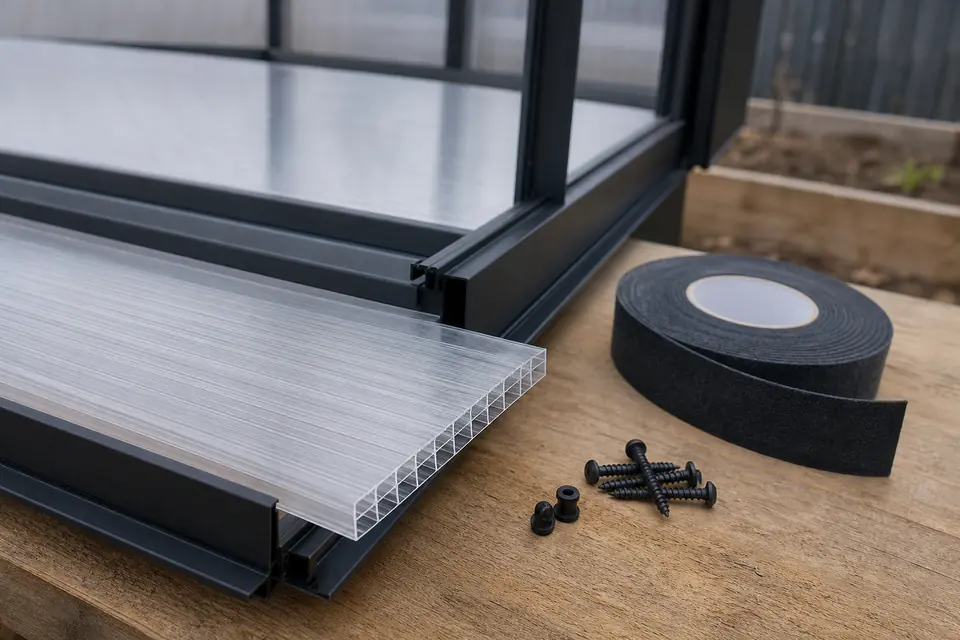
| End closure and tape | Multiwall channels need appropriate closure and drainage treatment to manage dust, moisture and insects. |
The panel is not the whole envelope
For rigid sheet projects, accessories carry real performance risk. A panel needs an installation approach that accounts for thermal movement, compatible fasteners, edge tape, end closures and water management. This is why a project can fail even when the panel itself looks thick enough.
Use the supplied installation manual rather than generic fastening advice. The manual is the authority for hole size, washer type, support spacing, UV-protected face orientation and the required allowance for expansion. If a seller cannot provide the applicable data sheet and instructions, comparison shopping has not reached the information you need.
Do not solve a structural question with a panel gauge
Snow and wind design belong to the structure and local requirements. Penn State notes that hard plastic panels are commonly used in greenhouses that withstand winter snow loads, but that is not a certification that any panel, frame or spacing will satisfy the load at your site.
A real cold-climate direction of travel
University of Minnesota Extension's deep winter greenhouse work illustrates a different level of decision-making: the greenhouse is oriented east-west, uses a steep south-facing glazing wall and stores solar-heated air in insulated soil or rock mass. The lesson is not to copy a particular design. It is that cold-climate performance is a system question: orientation, thermal mass, ventilation and glazing interact.
For a small conventional greenhouse, keep the same discipline at a smaller scale. Decide whether you are selecting a panel for durability, insulation, manageable maintenance or a particular frame. Then verify the product-specific numbers that serve that priority.
Common questions
Is a thicker panel automatically better?
No. Nominal thickness is only one variable. Check the exact panel construction, support spacing, light data, installation requirements and local structural needs.
Can I use a panel span chart from another brand?
No. Use the span table and installation instructions for the exact panel and profile system you are considering.