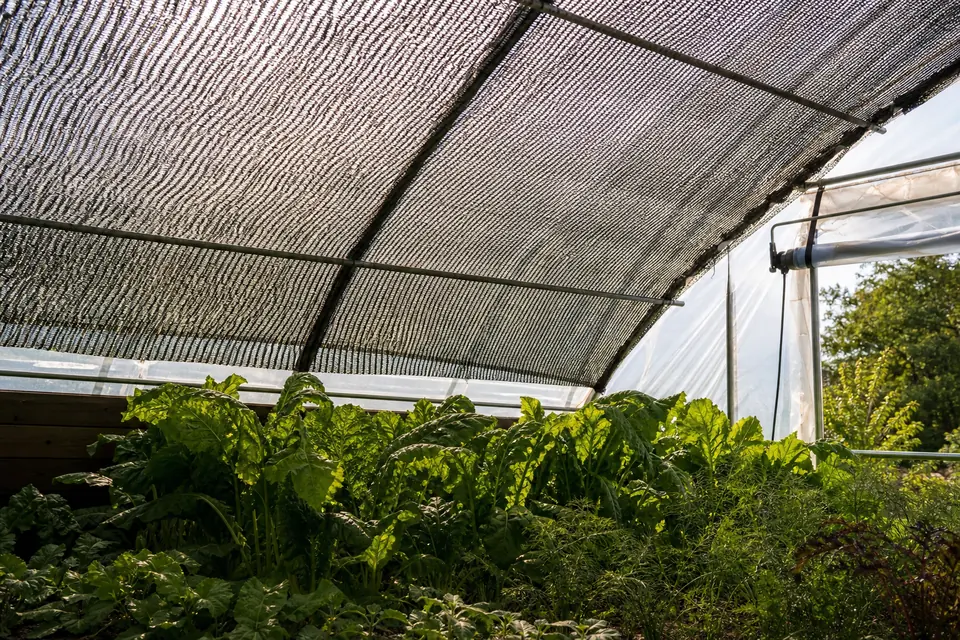
The percentage is light reduction, not a crop prescription
Shade cloth percentages are commonly presented as the amount of sunlight blocked by the material. But the final condition inside a greenhouse also depends on the existing cover, sun angle, fabric color and construction, location, roof vents, sidewall openings and crop canopy. A 40% cloth over a clear structure is not the same environment as the same cloth used inside an already diffusing cover.
UMass Extension notes that shade material is available from 10% to 100% shade and that, for many greenhouse crops, a 30-50% reduction can be satisfactory. The same source warns that too much shade limits light reaching lower canopy leaves. Treat that as a discussion range, not a replacement for knowing the crop's light requirement.
Are you trying to reduce solar gain before it enters the structure, protect a crop during part of the day, or reduce wind and glare at an opening? These are different uses for a material sold under the same shade cloth label.
A planning table, not a buying chart
| Situation to investigate | What to evaluate before picking a percentage |
|---|---|
| Summer heat in a clear-covered greenhouse | Ventilation capacity, whether external shading is possible, crop light needs and the months the cloth will remain installed. |
| Temporary crop protection | Time of day, duration, crop sensitivity and how quickly the cloth can be removed or adjusted. |
| Sidewall or endwall wind tempering | Required airflow, opening size and whether the fabric is intended as a breathable wall rather than roof shade. |
| Energy or shade screen system | Open versus closed weave, ventilation strategy, manufacturer shade factor and energy-saving data. |
A real case from Penn State: shade cloth used for airflow and wind tempering
Penn State's greenhouse-barn guidance gives a clear example of why use case matters. For ventilation openings, it states that no greater than 80% shade cloth should be used and identifies 50-60% as a compromise between airflow, shade and tempering strong winds in that livestock-barn application. For roofs in that specific hot-weather context, the guidance discusses 90-95% shade cloth to block excessive solar radiation.
That does not translate directly to a crop greenhouse. It does show that the same product category can be used at very different densities when the job changes from maintaining breathable sidewalls to blocking roof radiation. Copy the reasoning, not the exact number.
Light is only one half of heat management
Shade can reduce solar radiation before the structure heats up, but it cannot substitute for an exit route for hot, moist air. Penn State emphasizes that ventilation openings need unobstructed airflow; UMass distinguishes open-weave screens for naturally ventilated houses from closed-weave screens in fan-ventilated systems.
Before you buy a roll
- Measure the shaded surface and include a fastening allowance.
- Record whether the fabric will be roof-mounted, on sidewalls or over a crop zone.
- Read the fabric's stated shade factor, UV warranty and installation method.
- Plan removal or storage if the material is seasonal.
- Monitor the greenhouse after installation: temperature, humidity and crop response are the feedback loop.
Common questions
Does a higher shade percentage always cool a greenhouse more effectively?
It reduces more incoming light, but the greenhouse response also depends on ventilation, cover type, season and the crop. More shade is not automatically the better setting.
Can shade cloth replace ventilation?
No. Shade controls part of the incoming solar load. Hot and humid air still needs an appropriate route out of the greenhouse.